December 1873: Everyday Elizabeth Through the Daily Monitor
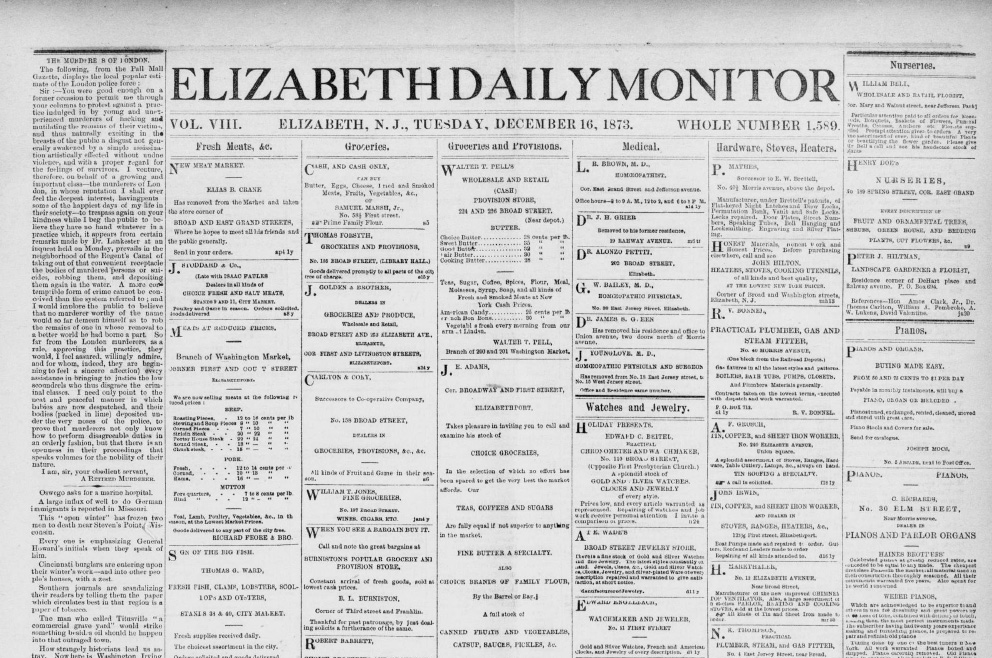
On a cold December day in 1873, an Elizabeth reader could turn to the Elizabeth Daily Monitor for much more than a headline. Its pages placed a weather forecast beside court reports, concert notices, railroad schedules, shop advertisements, political commentary, and dispatches from far beyond New Jersey. The paper did not tell one tidy story about the city. Instead, it offered a crowded, selective record of what its editors and advertisers thought readers should notice.
What can an 1873 newspaper tell us about everyday Elizabeth?
The Elizabeth Daily Monitor shows what one local paper placed before readers: civic notices, entertainment, rail information, advertisements, editorial opinion, and news from beyond New Jersey. It is a vivid but incomplete record of city life.
That is what makes an ordinary issue worth reading today. The Monitor was not a neutral diary of every resident’s life, and its pages cannot tell us what everyone in Elizabeth saw, bought, believed, or experienced. But the surviving December 15 and 16 issues show how one daily newspaper connected local information, commerce, entertainment, and regional travel in the fast-growing city.
A Daily Civic Noticeboard
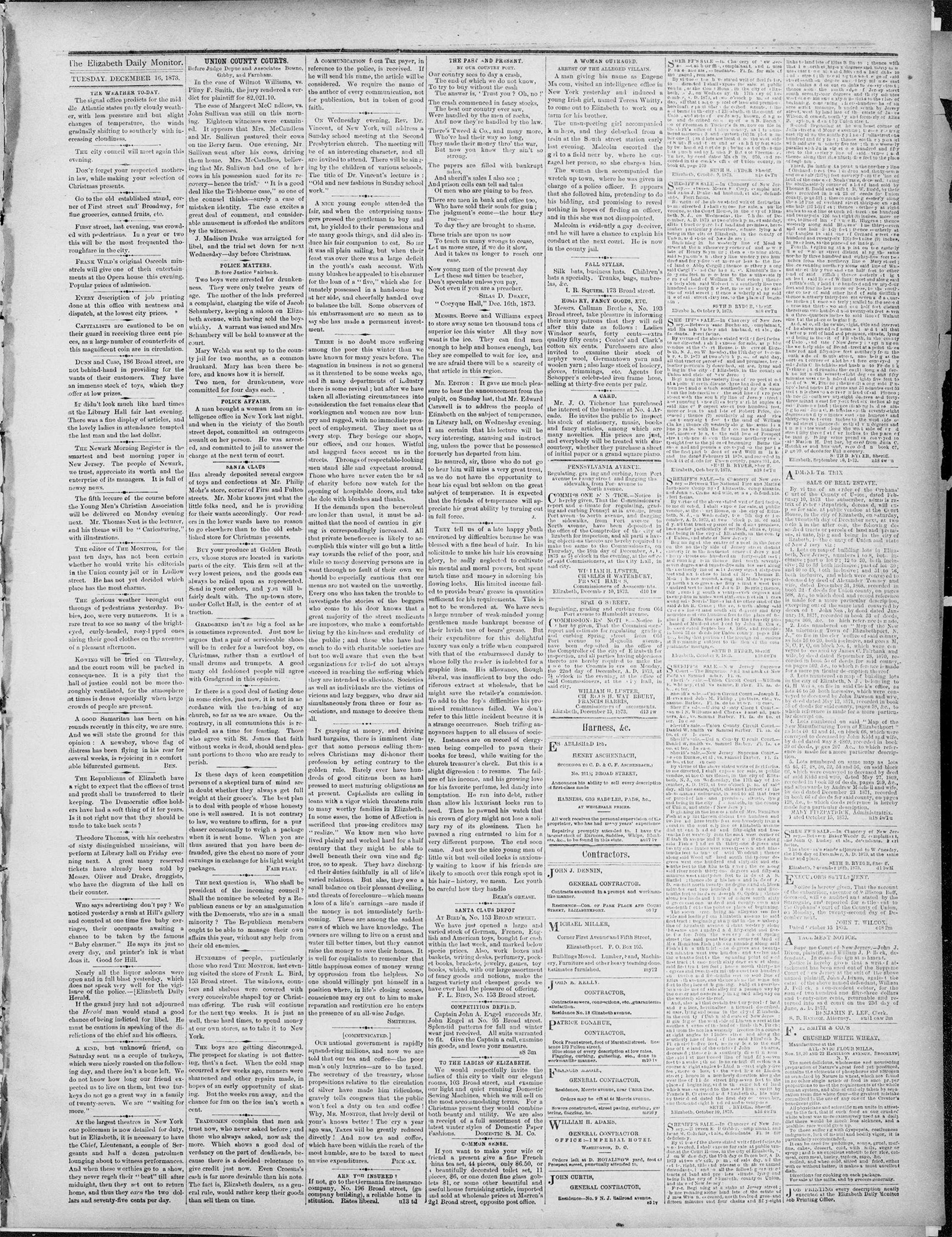
The December 16 issue moved quickly between kinds of information. A local weather item gave readers a short-term forecast. Nearby, the paper carried reports from Union County courts and brief local notices. Other columns promoted performances and meetings, including events connected with Library Hall and the opera house.
This mixture was part of the paper’s purpose. The Monitor‘s title history records that its founders promised coverage of City Council proceedings, court activity, public meetings, and other local matters. In practice, that local role shared the page with editorial opinion and stories copied or telegraphed from elsewhere. A reader looking for an Elizabeth announcement could encounter news from Cuba, Washington, or another American city in the next column.
For historians, the point is not to mistake every item for an event in Elizabeth. Rather, the paper shows the information environment available to readers: a local civic noticeboard embedded in a wider network of news.
Getting Around – and Looking Ahead
One of the clearest everyday services in the December 16 paper was transportation information. Its advertising pages printed Central Railroad of New Jersey schedules and notices for express service between Elizabeth and New York. The timetable presented travel as practical information readers could consult alongside local advertising and announcements.
The schedule does not tell us who traveled, how often trains ran on time, or whether fares were affordable to most residents. Still, it documents that regional movement was part of the newspaper’s regular commercial and informational landscape. Elizabeth was not presented as an isolated place; the page linked it to Newark, New York, and routes farther west.
For a present-day connection to Elizabeth’s transportation story, explore the Elizabeth Train Station (Welcome Station). Its visitor record describes a historic rail hub reimagined as an entry point for exploring the city’s history and culture. The 1873 timetable does not document the present station building or current train service; it offers earlier context for a city long connected to regional travel.
December also brought the familiar pressure of the holiday season. Notices promoted concerts and other entertainment, while advertisements offered clothing, furniture, groceries, medicines, books, toys, and services. Some businesses listed Elizabeth addresses; others advertised from Newark or elsewhere. Together, the ads made a kind of commercial map – not a map of what residents necessarily purchased, but of the choices merchants chose to place before the paper’s readers.
Reading the Gaps
The paper’s dense columns can feel immediate because they preserve names, streets, prices, and routines. Yet they are also incomplete. Advertisements were paid messages. Editorials reflected the paper’s political and editorial choices. Court and police items recorded what the newspaper chose to summarize, not a full account of a person’s life or a final legal outcome. And the absence of a person or community from these pages does not mean that they were absent from Elizabeth.
That limitation is part of the story. The Daily Monitor lets us see how a newspaper assembled a day’s attention in December 1873: a forecast, a court notice, a train schedule, an evening performance, a shop window in print, and news from far away. Read carefully, its pages offer not a complete portrait of everyday Elizabeth, but a vivid record of what one local paper placed in front of its readers.
Continue exploring Elizabeth’s place-based history through Historic Midtown Elizabeth and the Explore Elizabeth tours and landmarks guide.
Sources
- Elizabeth Daily Monitor (Elizabeth, N.J.), December 15, 1873, p. 1. Chronicling America, Library of Congress; provided by Rutgers University Libraries.
- Elizabeth Daily Monitor (Elizabeth, N.J.), December 16, 1873, pp. 1-4. Chronicling America, Library of Congress; provided by Rutgers University Libraries.
- Library of Congress title record for Elizabeth Daily Monitor.
Experience This History in Person